City cycling and urbanism
I have lived in suburbia for most of my life, and have been a passionate outdoorsman who craves wilderness for my entire life as well. I had always been skeptical of cities, and city-dwellers, despite enjoying my occasional visits to them. It's only recently become clear to me that my blanket dismissal of cities was foolish (there are great cities, and less-great ones, but even those can have great neighborhoods), and that the enjoyable qualities of cities were not unique to those singular areas, but are often due to urban design principles that can be applied to cities and neighborhoods in many other places as well. I am a very late convert to urbanism, and the benefits of dense and walkable cities.
I feel totally unqualified at this point to write much about urbanism and urban design, given the wealth of great discussion from others elsewhere. And I absolutely adore public transit, especially trains and subways, but don't have much to write about there either.
For now, most of this page will be for collecting resources for my next bicycle purchase.
I'll also add that seeing city neighborhoods and public transit networks around the world is becoming increasingly interesting to my Travel philosophy. As an example, during a recent one-day visit to Panama, I chose to ride the relatively new subway across Panama City to get to the airport, rather than a much faster and safer(?) Uber, and that experience came out to be far more interesting and fulfilling to me.
Inspiration and references
- Urbanism
- Books
- Jeff Speck - Walkable City
- David Byrne - Bicycle Diaries
- Ray Delahanty | City Nerd
- Books
- Bicycles
- Rivendell Bicycle Works
- r/xbiking
- The Radavist
- Velo Orange
- Bikepacking.com - more centered on gravel/backcountry riding, without racks or large panniers, but still interesting to view their bag-carry setups
- Cycle Touring with Rick Steeves - not that Rick Steves, a different one!
- Shopping guides
- CyclingAbout article directory
- WhatBars - handlebar comparison
- BikeInsights - frame geometry comparison
- Sheldon Brown
- Books
- Grant Petersen - Just Ride
- Zinn and the Art of Road Bike Maintenance
Current bicycle
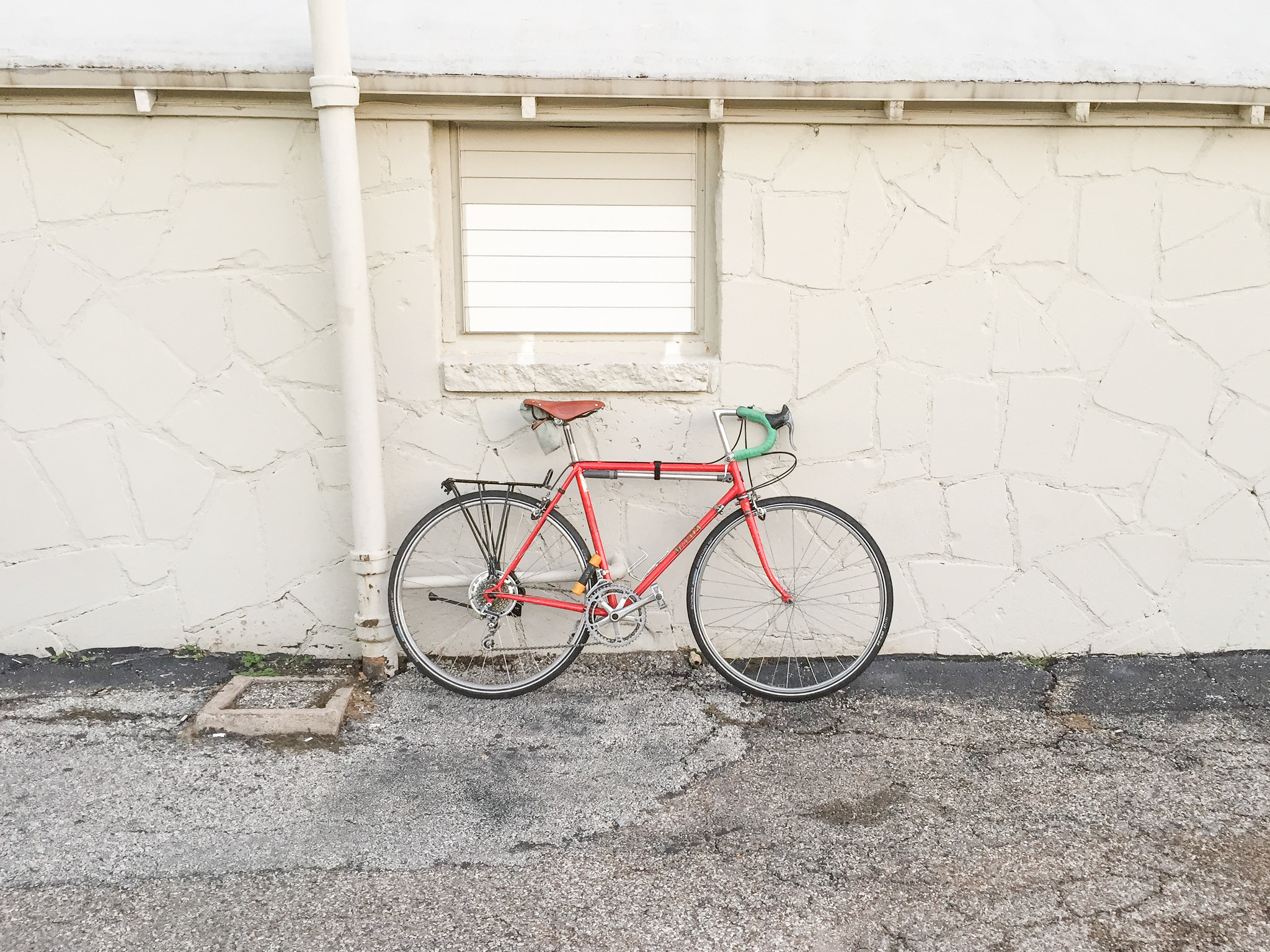
An old Miyata Seven Ten sport/commuter bicycle, steel-framed, built in 1981 according to the serial number. The Miyata 1981 catalog contains information on the frame geometry and original components. Bought at a used bicycle shop in Austin TX around 2011. Heavily customized, inspired by Rivendell Bicycle Works, and the need for something practical.
I love this thing, it's one of my most beloved possessions. But among other issues, the gears and chain are slowly wearing out, and finding replacement parts is only possible through scavenging other old bikes, or considerable expense. Its gear ratios are also insufficient for climbing hills. Though I still hope to keep this bicycle for a long time, the futures for it are narrowing.
Parts that I added/replaced:
- Switched from downtube shifters to bar-end shifters
- Taller stem
- Brooks B17 leather saddle, as the old one disintegrated
- Kickstand, mounted on the chainstays
- Schwalbe Marathon tires, as the old skinny road tires disintegrated
- BMX Pedals
I believe the previous owner replaced the stock pedals with tiny clipless pedals, which I quickly replaced. They also added the rear rack, which was greatly appreciated.
Using this gear inches calculator, this bike only has around 44" for climbing (700c rims, chainrings have 39 and 52 teeth, sprockets run from 13 to 24). Lower is better, and something like 20" would be preferred! On the high end, it gets 108", which is slightly more than a 1x setup like a Surly Preamble, but that's much less important for me.
Future bicycles
I'm currently torn between an acoustic commuter bike, a rack-equipped e-bike, a longtail cargo e-bike, or a frontloader cargo e-bike. Pros and cons discussed below. Or perhaps I should get multiple bicycles?
An acoustic bike is making an increasing amount of sense to me, so a variety of options are listed.
Acoustic commuter bikes
- Pros
- 'Pure' cycling experience
- Easy maintenance, including in the field, and most future-proof
- Most customizable
- Good for physical fitness, sport-ier look and feel
- Most affordable, and replaceable in case of theft
- Lightweight and compact
- Cons
- Mental reluctance to go on longer or faster rides, especially if cargo-loaded
- Can't easily carry children
- Build I am currently considering - touring-focused steel bike, with long chainstays, drop bars mounted relatively high (level with saddle), bar-end or thumb shifters, and capability for racks and fenders. Flexible on number of chainrings, as long as climbing gears are available (gear inches around 20" are recommended for touring climbs), even most modern 1x drivetrains are sufficient. Will want to add kickstand, in addition to whatever is missing of above.
- Options
- Surly Preamble - $1100 - $1600 - in-stock locally, but shorter chainstay, brifters
- Surly Disc Trucker - $1800 - brifters
- Fuji Touring Disc - $1500 - includes rear rack, bar-end shifters
- Marin Four Corners 1 - $1250 - brifters
- Jamis Steel Renegade - $1500-$1700 - brifters
- Rivendell - ~$4000 - also needs racks
- Craiglist for old bikes - ~$250, though future-proofing and parts replacement somewhat of a concern
- Bikeforums thread on Surly, Soma, and other brands that re-badge/paint generic components (not a bad thing, if the component is good)
- Rear racks, since they're often not included - bonus if there are lower pannier rails
- Ortlieb Quick Rack - $130 - 580g - holds 44 lbs
- Old Man Mountain Divide - $168 - 960g - holds 55-70 lbs
- Velo Orange Campeur - $185 - 780g - holds 40 lbs
- Tubus Logo Classic - $200 - 630g - holds 57 lbs
Rack-equipped e-bike
- Pros
- Most conventional e-bike, won't attract attention
- Relatively customizable?
- Cons
- Can't easily carry children if rear rack not long enough
- E-bikes not future-proof, heavy, field repairs may be challenging, not as good for physical fitness, and few postures available other than upright
- Examples
- Marin Sausalito E1 ST
- Yuba Boda Boda
Longtail cargo e-bike
- Pros
- Cargo carried lower, for better balance and ride experience
- Slightly more flexible cargo area for larger items, and for children
- Cons
- Smaller back wheels, less efficient and sporty?
- Less conventional appearance
- E-bikes not future-proof, heavy, field repairs may be challenging, not as good for physical fitness, and few postures available other than upright
- Examples
- Yuba FastRack
- Yuba Spicy Curry
- Tern
Frontloader cargo e-bike (Bakfiets/Long Johns)
- Pros
- Extremely versatile, most like a car replacement
- Cargo carried lowest, for better balance
- Front view of cargo
- Most versatile cargo/children carrying options
- Most enjoyable for children to ride in
- Cons
- Steering feel takes getting used to, since front wheel not attached to steerer
- See this Urban Arrow review for some first-hand discussion
- Most expensive
- Least conventional appearance
- Long, needs storage space, may not fit at some bike racks
- E-bikes not future-proof, heavy, field repairs may be challenging, not as good for physical fitness, and few postures available other than upright
- Steering feel takes getting used to, since front wheel not attached to steerer
- Examples
- Urban Arrow FamilyNext Pro
- Yuba SuperCargo CL